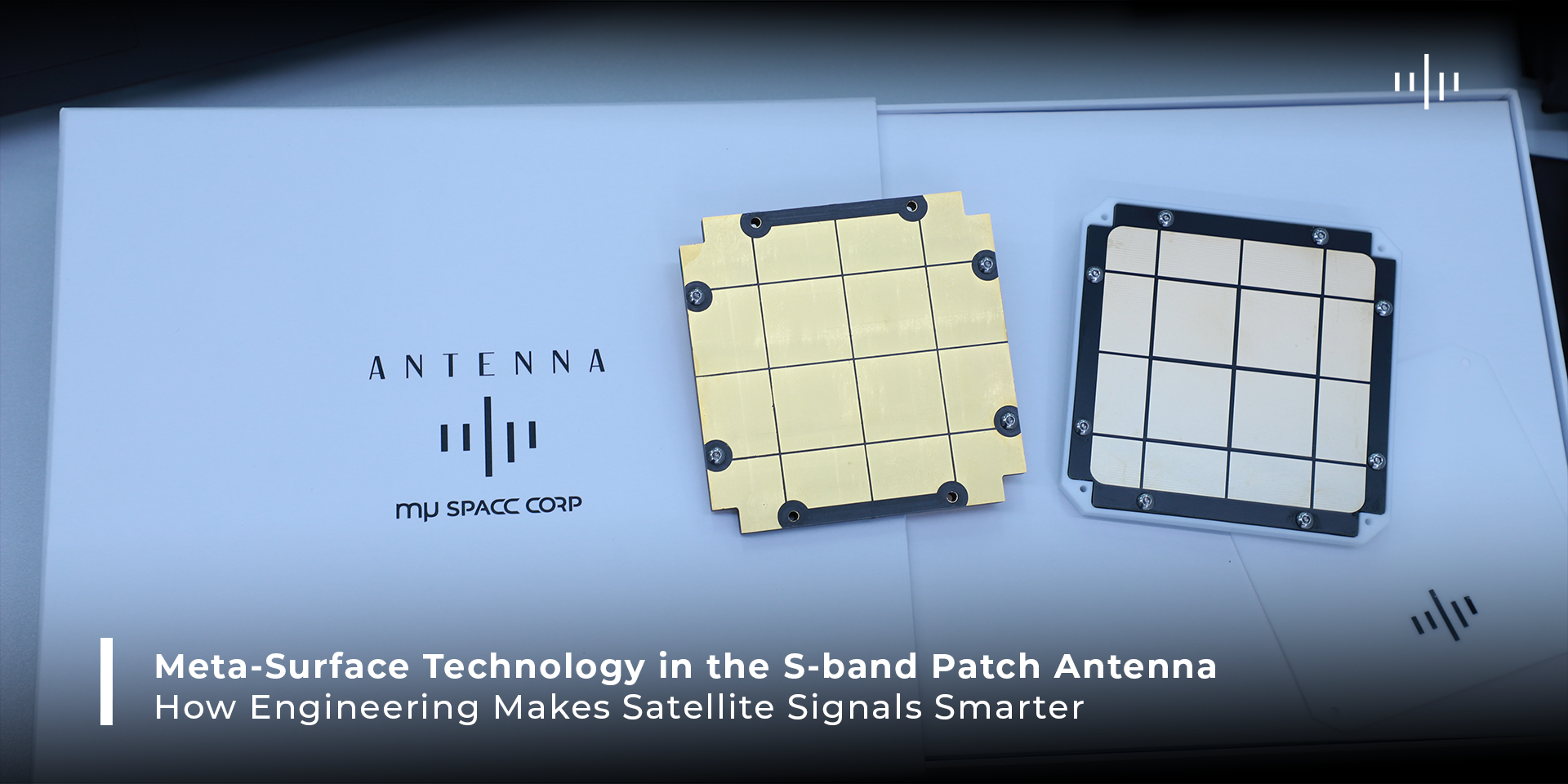
Meta-Surface Technology in the S-band Patch Antenna How Engineering Makes Satellite Signals Smarter
A look inside mu Space's wideband, circularly polarized, low-profile antenna for low-Earth orbit satellites.
Every satellite needs a good voice
Every satellite in space has a job. It may take photos of the Earth. It may watch the weather. It may carry internet signals. To do any of this, the satellite must talk to the ground. The antenna is that voice and that ear.
A strong antenna means clear commands going up and clean data coming down. A weak antenna means lost signals and failed missions.
mu Space has built an S-band Patch Antenna that is small, light, and smart. The secret behind its strength is a modern idea called Meta-Surface Technology.

What is a meta-surface?
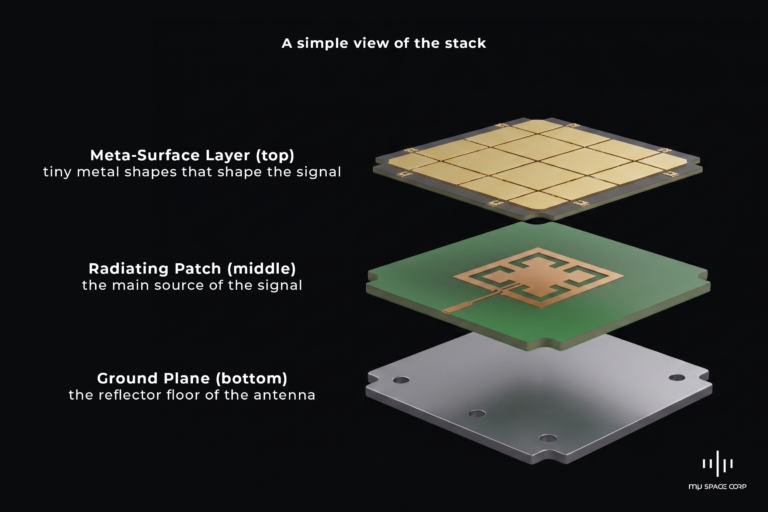
Think of a meta-surface as a grid of tiny printed shapes on a flat board. Each shape is smaller than the radio wavelength. When radio waves meet this grid, the surface guides and shapes those waves in useful ways. The result is an antenna that stays thin and light and still performs at a high level.
Our antenna uses two stacked layers of RO4003c, a high-quality space-grade material. The lower layer holds the main radiating patch. The upper layer carries the meta-surface grid. The two layers work together as a team.
Three smart features in one thin board
- Wideband performance
A simple antenna works at only one narrow frequency. Our meta-surface antenna covers a wide range, from 2025 MHz to 2290 MHz. One antenna can handle both telecommand signals going up to the satellite and telemetry data coming down. One antenna replaces two. This saves space, mass, and cost on every mission.
- Circular polarization
Signals in space twist and rotate as they travel. A basic linear antenna may lose the connection during the twist. Our antenna sends and receives in Right-Handed Circular Polarization (RHCP). The link stays solid even when the satellite rolls or spins. Our measured axial ratio is under 3 dB, a clear sign of clean circular polarization.
- Low-profile design
The antenna is only 98 × 98 mm wide and just 3.12 mm thin. It weighs about 139 grams. It sits flush against the satellite body. Small satellites such as CubeSats have a tight mass budget and a tight space budget. Our antenna respects both.
Real test results from real chambers
Our antennas were tested at the High Frequency Systems Laboratory at TGGS, King Mongkut’s University of Technology North Bangkok. The measurements were done in a professional anechoic chamber using a Keysight E5063A vector network analyzer. Here is what we measured on the High-Gain version:
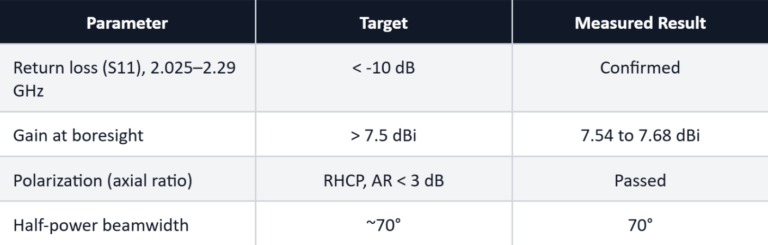
The measurement numbers align closely with our CST Studio simulation. Design, simulation, and real measurement all point to the same story. That is the mark of careful engineering.
Engineering, world-class quality
The mu Space team carried this antenna from the first sketch all the way to a tested prototype. We wrote the design report, ran the simulations, built the hardware, and verified the results with certified test partners. Seven antennas were produced and four of them passed every technical requirement of the delivery contract. Advanced space technology can now be designed and built in Thailand.
Our S-band Patch Antenna is ready for low-Earth orbit missions. It is small. It is smart. It is proven. And it is made by mu Space.